Our Organisation Search Quick Links
Toggle: Topics

Water Quality in Ireland

Water is a critical natural resource. Ensuring Ireland has water of good quality available across the country is essential from an economic and quality of life perspective. Our water is used for drinking, industry, energy generation and recreation. Water is also home to a wide variety of plants and animals.

Increasingly Ireland has to look at the impact of human activities on water quality on a global and local scale. Our activities can have a positive or negative influence. Activities impacting water quality are agriculture, hydromorphology (physical changes to waterbodies), urban and domestic waste water, forestry, peat extraction, industry and roads.

Climate change has resulted in more frequent storms and heavier rainfall or droughts. These impact water quality, putting increased strain on supplies and on Ireland’s ability to maintain and improve water quality.

To find out more, download the EPA Water Quality in Ireland 2019-2024 report here.

Water Policy and Targets

In Ireland, all water policy and management is guided by the EU Water Framework Directive (2000/60/EC). Under this directive, Ireland has been set a target of achieving at least ‘good status’ for all waters in the country, along with no deterioration. Despite a lot of good work over the last 20-30 years, we are falling short in achieving this target and water quality has declined in recent years.

Although overall water quality in Ireland compares favourably to the EU average, meeting objectives under the Water Framework Directive, whereby all waterbodies achieve good status by 2027, will be challenging. The latest Water Quality in Ireland report (Environmental Protection Agency, 2025), which refers to the period of 2019 – 2024, highlights that 52% of surface waterbodies are at good or high status.  This is a decline from the 2016-2021 assessment when 54% of surface waterbodies where in good or high status.

The main causes of unsatisfactory water quality are:

• Run-off of nutrients, sediment and pesticides from agricultural lands and farmyards;
• Activities such as land drainage, dredging and the presence of barriers such as dams, weirs or culverts in water courses;
• Discharges of poorly treated sewage from urban waste water treatment plants, domestic treatment systems and storm water overflows;
• Run-off from hard surfaces in urban environments of sediment and contaminant loaded water; and
• Run-off of nutrients and sediment from forestry operations.

Agriculture remains the main pressure on waterbodies, followed by hydromorphological changes and the forestry sector.

Improving water quality

As part of the second and third Irish River Basin Management Plans, Priority Areas for Action (PAAs) were created, within which actions are being targeted to improve water quality. These are implemented collaboratively by the Local Authorities Water Programme (LAWPRO), the Agricultural Sustainability Support and Advisory (ASSAP) Programme, local authorities and other stakeholders. In these PAAs, although ecological status has not yet improved, there is evidence of declines in phosphorus concentrations, which are a welcome first step. It is crucial that positive actions are maintained to continue this trajectory of progress.

You can find out more about current water quality in Ireland by visiting Catchments.ie.
Agriculture impacts on water quality

Agriculture is the main pressure on water quality in Ireland as it is the largest land use in the country. Water contaminants that arise from agricultural activities include:

  • Excess Nitrogen (N)
  • Excess Phosphorus (P)
  • Sediments
  • Pesticides
  • Pathogenic faecal organisms

How does agriculture and farming contribute to these losses?

Farming practices and food production utilise the soil to grow grass for dairy, beef and sheep farming and crops, vegetables and fruit for the tillage and horticulture sectors. This utilisation of the soil and addition of fertilisers and pesticides can lead to losses of nutrients, sediment and pesticides to waters. These inputs need to be carefully managed and farming practices implemented that are appropriate to each individual farm (i.e. to site-specific characteristics such as soil type, topography, etc and management aspects such as stocking rate) and weather conditions.

Water pollution sources can be broadly categorised as point sources, which are discrete (for example a pipe discharging to a waterbody), or diffuse sources, which originate across the landscape (for example, surface runoff). Diffuse sources of pollution are challenging to tackle and require targeted and integrated management. Additionally, mitigating water pollution from agriculture can involve different strategies depending on what contaminant is being targeted, as P, N and other contaminants behave differently in the landscape and reach surface waters through different processes.

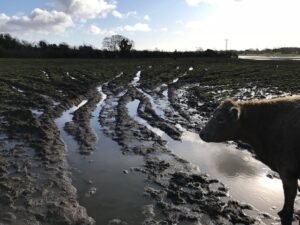
This image shows a pasture with waterlogged soils and overland flow exacerbated by livestock.

Overland flow on pasture exacerbated by livestock overwintering.

Excess nutrients can lead to eutrophication of waters which can result in fish kills, and harmful algae blooms. Excess sediments smother the riverbed, reducing habitat available for aquatic invertebrates and for fish spawning. Faecal microbes may contaminate drinking water supplies and cause illness outbreaks; pesticides and other chemical compounds (for example veterinary drugs and microplastics) also have implications for human health. Water pollution from agriculture can impact not only inland waters (groundwater, rivers and streams, lakes and reservoirs) but also transitional (estuaries) and coastal waters.

Diffuse N, P and sediment losses

Phosphorus (P) loss typically occurs on soils that have low permeability. These are ‘heavy’, poorly draining soils with high clay content and get quickly saturated with rainfall. When there is heavy rainfall on these saturated soils, this leads to the water staying on the surface of the soil. This in turns leads to overland flow of water, particularly on fields with slopes.

The overland flow of water across fields brings with it P available to plants in soluble form from fertiliser application. It also washes off soil particles that have P attached to them, as P binds tightly to soil particles. The soluble P and soil particles can then be washed into the drainage network and streams located in the farm. Tackling P and sediment losses from agricultural land often involves measures such as sediment traps, ponds or riparian buffers, which intercept overland runoff and help retaining P and sediments before they reach aquatic systems.

Nitrogen (N), particularly nitrate, is very soluble and thus loss typically occurs on soils that have high permeability. These are ‘light’ free draining soils with a high sand content and water can quickly permeate through these soils.

Where N fertiliser is applied above crop requirement, is not fully utilised by the grass or tillage crop and is left in the soil. This residual N can be leached to groundwaters and eventually reach surface waters. Addressing N pollution often involves source control measures and practices, for instance matching N fertiliser application to crop requirements so as to reduce N excess (or N surplus), or the use of cover crops to utilise N left in soils over the winter season.

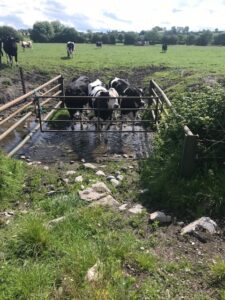
This image shows dairy cattle standing in a stream, in a discrete drinking water point. Bank trampling is visible.

Direct livestock access to watercourses can also contribute to water pollution due to direct excretion into waters (adding nutrients, microorganisms and particulate matter) and bank/channel damage and erosion.

Artificial drainage channels are also known to transport both P and N to waters, in effect bypassing natural processes such as soil filtering. The extent to which artificial drainage leads to increased contaminant transport to aquatic systems depends on several factors, including how well-connected these systems are to waterbodies. Poorly designed and/or poorly maintained roadways can also represent pathways of pollution to waterbodies.

Working together to improve water quality

Teagasc is committed to working towards improving water quality in Ireland whilst supporting the production of high-quality food.

The Agricultural Sustainability Support and Advisory Programme (ASSAP) is a free and confidential service working with farmers in 190 water quality priority water catchments in Ireland.  Together with the Local Authority Waters Programme (LAWPRO) advisors from both Teagasc and the dairy industry are helping farmers in these areas put in place mitigation measures to improve water quality. To find out more about ASSAP, visit the ASSAP page here.

In 2024, Teagasc launched the Better Farming for Water Campaign, a collaborative approach to share knowledge and support farmers in implementing farming practices to mitigate agricultural pressures. This campaign is currently focused on the southeastern half of the country, where about 40% of the land is at high risk of N losses, and elevated nitrate concentrations in waters are a concern. Follow this link to find out more about the Better Farming for Water Campaign and the 8 Actions for Change.

Alongside its work on the ground, Teagasc has developed research to assess water quality and the factors and mechanisms driving it, as well as implementing and evaluating mitigation measures and practices. The Agricultural Catchments Programme, ongoing since 2008, has gathered a unique and substantial set of environmental, agronomic and socioeconomic data in 6 study catchments selected to be representative of Irish conditions and agricultural enterprises. Find out more about the Agricultural Catchments Programme by following this link, or visit this page to read about other Teagasc environmental research projects focused on water quality.