
24 March 2025
Advancements to maximise the value of nutrients in slurry for cereal crops
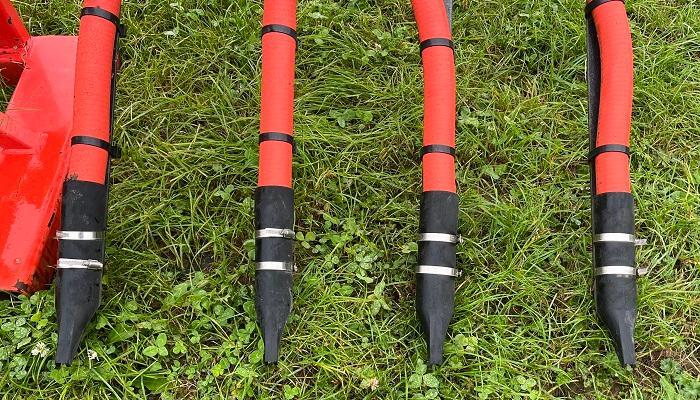
John Mahon, Teagasc Signpost Tillage Advisor, tells us about how advancements in machinery technology have improved management of slurry application to cereal crops allowing optimisation of nutrient recovery and lower chemical fertiliser costs.
Many Irish tillage farmers have recognised the importance of incorporating some form of organic manure into their rotational cropping system to cash in on the benefits which were perhaps taken for granted in mixed farming systems in the past.
Improved soil structure, health, & biological improvements as well as increased soil organic matter and trafficability cannot be provided from chemical fertiliser. But these are some of the benefits observed when using organic manures over a period of time on tillage land. The other main benefit is as a direct replacement for at least some of the N, P, K requirements of the crop, lowering the chemical fertiliser spend, reducing the carbon emissions associated with chemical nitrogen, while improving water quality.
Traditionally, the advice for those choosing to apply cattle or pig slurry to crops was to apply the slurry to the stubbles and incorporate into the soil by ploughing within 6 hours or by stubble cultivation in the case of non-plough based establishment systems prior to sowing. While this advice still holds true for many of the benefits outlined above, the one main drawback is recovery of the nitrogen fraction may be small especially when applied in autumn to winter sown cereals. This is normally carried out using slurry tankers and applied directly from the shed in September. Another drawback to this method is the time constraint, particularly if the distance from the yard is >2km along with cost issues associated with long haul transport at time of application.
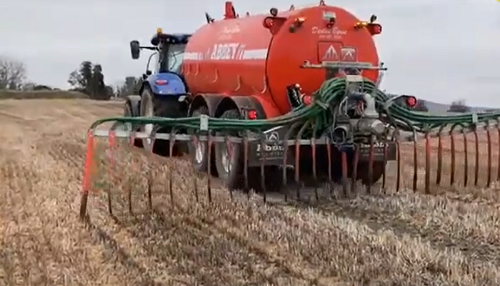
However improved technology with the introduction of umbilical application systems to Ireland has meant that this task can now be carried out quickly in the field with up to three times greater daily coverage compared to conventional tanker applications.
This method uses an applicator attached to the back of the tractor linked to a supply of slurry on a continuous flow basis through a hose mechanism fed from a second tractor mounted stationary pump located at an on-site slurry storage tank, or nursery feed tank in the field. As this is fed continuously, up to 200 acres per day can be covered when slurry supply is adequate and easy movement between fields is possible.
The applicator uses dribble bar or trailing shoe technology complying with the Low Emission Slurry Spreading (LESS) obligation in the Nitrates Directive while reducing both odour and gaseous emissions. The other distinct advantage is that the applicator units weigh between one and three tonnes, so weight and compaction are greatly minimised in comparison to tanker application. Typical application widths are 8m, 9.5m or 12m units.
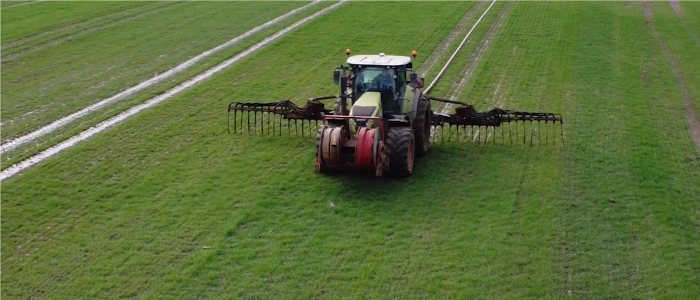
Because the unit weighs much less the possibility of driving on sown cereal ground is achievable, something which is quite difficult to achieve with a slurry tanker.
As a consequence, the option of applying slurry to a growing crop has become a reality. In the case of a spring application to a winter sown cereal this means that it is now possible to recover almost all of the applied nitrogen in the slurry provided the crop is growing (typically in mid to late March), compared to quite low recovery when autumn applied due to low soil temperatures, smaller plants and lack of growth for nitrogen uptake. Recovery of P and K are quite similar if applied in autumn or springtime.
As with chemical fertiliser, all organic manure applications should only take place where there is a requirement for the nutrients and at rates in accordance with the individual field soil sample results and the farm Nutrient Management Plan (NMP).
The future
Latest technological advances have meant that umbilical systems are now being built to match crop tramline widths to allow applications to be made without having to drive on the crop. This advancement has opened up the possibility of making a second application (if the NMP allows) after Growth Stage (GS) 30 of the crop at which point permanent damage would be the consequence of driving on the crop. Again this later application timing would mean that nitrogen recovery would be high due to the fact that the crop would be in full growth and receptive to a large uptake of nitrogen.
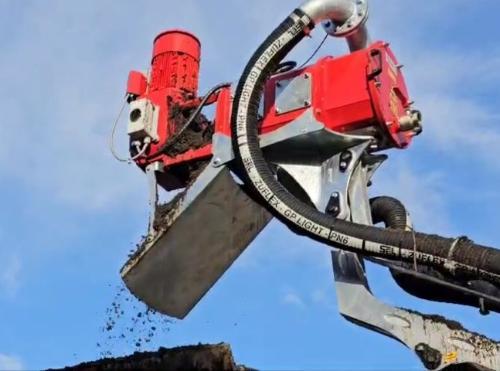
Another key development in the slurry area is the availability now of slurry separation units which are mobile and can be used to separate the slurry into a mainly solid fraction and a liquid fraction. Depending on the dry matter required which can be set on the machine, up to 100% of the P and K in the slurry may be retained in the solid fraction while up to 70% of the N can be retained in the liquid fraction. The practical consequences of this would mean that nitrogen may be retained in organic form on the farm while P and K could be exported in the case of farms where P and K indices of 4 are present. This solid fraction can be transported at a much lower cost to fields which have low P or K index soils and could be applied in either autumn or springtime. The liquid fraction containing mainly N could be used as an organic N source for second applications to tillage crops at later timings from GS 30 to 33 using the tramline width applicators with little damage to the cereal crop from the trailing hose.
The recent provision for TAMS 3 Nutrient Importation Storage Scheme (NISS) at 70% grant aid, in conjunction with technological developments have helped to advance the idea that movement of slurry to tillage farms may become more normal going forward.
Upcoming Signpost Tillage Farm Walk
If you would like to see a live demonstration of this technology in practice, join us at the Signpost Tillage Programme farm walk on Tuesday 25th March 2025 on the farm of Mattie & Miriam Moore, Croghan, Co. Offaly (11am to 1pm). This event will offer an opportunity to see the the technology in action, talk to experts and learn more.
Read more from Teagasc Daily: In-crop slurry application to cereal crops – timely tips