
02 October 2023
Annual meadow grass showing more resistance to herbicides
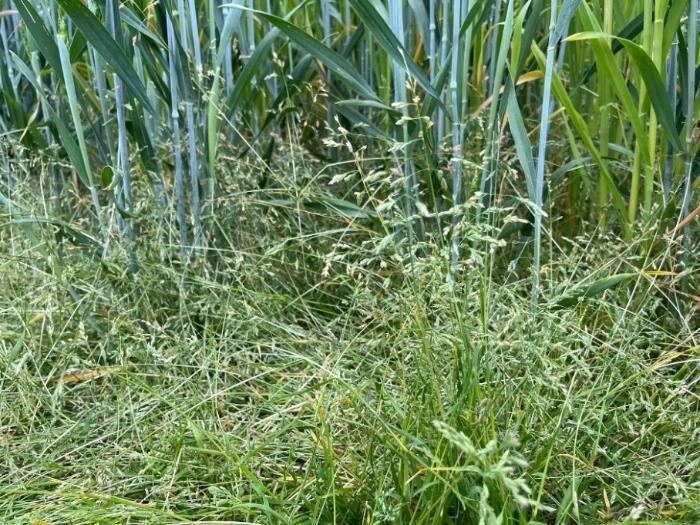
Leaving annual meadow-grass or grass-weed control until the spring is the least effective strategy, which may run the risk of resistance onset, writes Vijaya Bhaskar
Annual meadow-grass is abundant in all tillage fields. It is primarily a self-pollinating grass, germinating all-year round, with peak emergence from April to September. It hardly ever grows in isolation and is often found with broad-leaved and other grass weeds. In most years, it is considered a lower priority weed in weed control programmes, due to its relatively modest impact on crop yield than other weeds. However, in recent years, particularly since the removal of IPU from the market, its control has become more difficult in winter crops.
Additionally, herbicide-resistant populations are now present in Ireland, with some herbicides (eg. ALS-Pacifica) are no longer controlling annual meadow-grass. Farmers now need to pay more attention to prevent resistance build-up in the grass-weed on their farm.
The following practices can result in poor control of annual meadow-grass:
- Continuous winter cropping
- Earlier sowing of winter wheat
- Non-inversion tillage, especially in a wet year
- Poor early-season weed control:
- Using glyphosate at sub-optimal rates
- Not using autumn residual herbicides or using herbicides with a poor activity on annual meadow-grass (eg. DFF)
- Relying solely on a spring application of a broad spectrum herbicide like ALS-Pacifica to control problem grass (including annual meadow-grass) and broad-leaved weeds.
For winter crops: spring herbicides should not be first option
Remember, in winter cereals, post-emergent spring herbicides should only be used judiciously – to tidy up any remaining weeds following autumn treatments, or, if necessary, as a follow up treatment to prevent weed problems from later emerging plants.
Not using autumn herbicides and relying completely on a spring application for weed control will render spring herbicides ineffective and highly vulnerable.
Chemical options to control annual meadow-grass
- Glyphosate (at least 1.5 L/ha or above) before sowing the crop to kill all emerged plants
- Residual herbicides applied at full label rates as pre-emergence or early post-emergence is the most effective way to control annual meadow-grass.
- Use stacked (Table 1) or tank-mix flufenacet or pendimethalin-based products (eg. Firebird containing flufenacet and DFF + Defy containing prosulfocarb) no later than when plants have 1-3 leaves emerged.
- For spring barley crops, some of the pendimethalin-based products (eg. Stomp Aqua) are also available for use.
- Remember, DFF predominantly provides broad-leaved weed control with some annual meadow-grass activity, so when used alone will result in poor grass-weed control.
- Although, most susceptible grass-weed populations are sensitive to ACCase herbicides, annual meadow-grass show natural tolerance to Axial, Falcon and Stratos Ultra due to the inherited target mutation point of ACCase. Despite this natural trait, ACCase-Centurion Max still provide effective control.
- ALS-type herbicides applied at full label rates are the only available post-emergent option to control annual meadow-grass in late autumn or spring (Alister Flex – up to GS29; Monolith – up to GS25; Pacifica up to GS31), and this is only practicable in winter wheat crop (Table 1).
Table 1: Weed (including annual meadow-grass) control options in winter cereals
| Active | Trade name | Target key weeds controlled |
| Pre- or early autumn post-emergence (Winter wheat & winter barley) | ||
| Fluefenacet + DFF + metribuzin | Firebird Met | Annual meadow-grass, blackgrass, chickweed, groundsel, common speedwell, mayweeds |
| Fluefenacet + DFF + flurtamone | Vigon | Annual meadow-grass, blackgrass, Italian ryegrass, chickweed, cleavers, Ivy-leaved speedwell, mayweeds |
| Flufenacet + picolinafen | Pontos | Annual meadow-grass, Italian ryegrass, charlock, chickweed, poppy, Ivy-leaved speedwell, field pansy, may weeds |
| Fluefenacet + DFF | Firebird | Annual meadow-grass, Ivy-leaved speedwell, common speedwell, mayweeds, field pansy, groundsel |
| Pendimethalin + DFF + chlorotoluron | Tower | Annual meadow-grass, cleavers, charlock, chickweed, poppy, field pansy, mayweeds, speedwell, fumitory |
| Pendimethalin + picolinafen | Flight | Broad spectrum: Annual meadow-grass, charlock, cleaver, chickweed, common speedwell, poppy, corn marigold, fat-hen, field pansy, may weeds, Ivy-leaved speedwell |
| Pendimethalin | Stomp Aqua | Broad spectrum: Annual meadow-grass, blackgrass, awned canary grass, rough-stalked meadow-grass, fumitory, chickweed, poppy, corn marigold, fat-hen, field pansy, red shank, speedwells |
| Prosulfocarb | Defy | Annual meadow-grass, rough-stalked meadow-grass, Ivy-leaved speedwell, chickweed, common speedwell |
| Late autumn or early spring post-emergence (winter wheat) | ||
| Mesosulfuron + iodosulfuron + DFF | Alister Flex (ALS) | Annual meadow-grass, black-grass, rye-grass, rough-stalked meadow grass, charlock, chickweed, fumitory, groundsel, mayweeds, field pansy, common speedwell, fumitory |
| Spring post-emergence (winter wheat) | ||
| Mesosulfuron + iodosulfuron | Pacifica Plus (ALS) | Annual meadow-grass, rough-stalked meadow grass, rye grass, blackgrass, wild oats, sterile brome, rye brome, great brome, chickweed, mayweeds, charlock |
| Mesosulfuron + propoxycarbazone | Monolith (ALS) | Annual meadow-grass, rye grass, blackgrass, wild oats, sterile brome, rye brome, chickweed, mayweeds |
First ALS-resistant annual meadow-grass
The only confirmed case in Ireland to date was found in a continuous winter wheat production field in Dublin (Figure 1). However, more cases have been seen in fields this season, but confirmation is needed from the laboratory.
So far, resistance has been found in ALS herbicides – Pacifica and Broadway Star (not registered for annual meadow-grass control).
Annual meadow grass has been found to have developed resistance to 10 different herbicide modes of action (including glyphosate, propyzamide, pendimethalin, etc.) ranking it as third most important herbicide-resistant weed, internationally.

Figure 1: Symptoms of susceptible and resistant populations of annual meadow-grass 30 days post-treatment with a range of ± recommended field rates (highlighted in yellow) of ALS herbicides Pacifica Plus (A) and Broadway Star (B). The top population is from a Dublin farm with the bottom a reference herbicide sensitive population. Both ALS herbicides were very virtually ineffective.
How to reduce the risk of resistance development
- Delayed drilling and use of one, or two, applications of glyphosate as a part of a stale seedbed strategy.
- Increase the seeding rate especially where when planting late or in less than ideal conditions
- Include spring crops in the rotation
- Include non-cereal break crops (eg. winter oilseed rape)
- Use of Katamaran (metazachlor) pre-emergence for annual meadow-grass control.
- Use of Kerb (propyzamide) for early post-emergence control of volunteer cereals and other problem grass (including annual meadow-grass) and broad-leaved weeds.
- Where control is poor, use Centurion max (Clethodim) as a follow up option.
- Spray as early as possible, ideally with pre-emergence or at the latest early post-emergence with a residual herbicide.
- Ploughing perhaps can reduce grass-weed populations but not always.
- Strategic spot spraying
- Keep machinery clean from one field to the next.
- Establish perennial-grass based mixtures in field margins.
In brief
- Multi-pronged attack early in the season is key to managing grass weeds, especially annual meadow-grass
- Ensure correct actives and effective products, correct application timing and robust herbicide rates for maximum efficacy.
- Spring herbicides should not be used as the main herbicide in winter crops and only in a tidy up situation.
ECT Conference on November 08th in the Killashee Hotel, Naas
- The conference will hear results from the Enable Conservation Tillage (ECT) project and farmers who participated in the project.
- This conference will cover a wide range of topics covering all grass weeds, herbicide resistance, and cultural control options across all establishment systems.
- Free for everyone to attend.