
16 July 2024
Journey to more sustainable farming showcased at Johnstown Castle Open Day
A major Teagasc Open Day took place today, Tuesday, July 16, at the Teagasc Environment, Soils and Land Use Research Centre, Johnstown Castle, Co. Wexford.
Opened by the Minister of State at the Department of Justice, James Browne T.D., the open day featured all the key benchmarks and indicators for sustainable farming systems, along with sharing details as to how they can be reached by farmers.
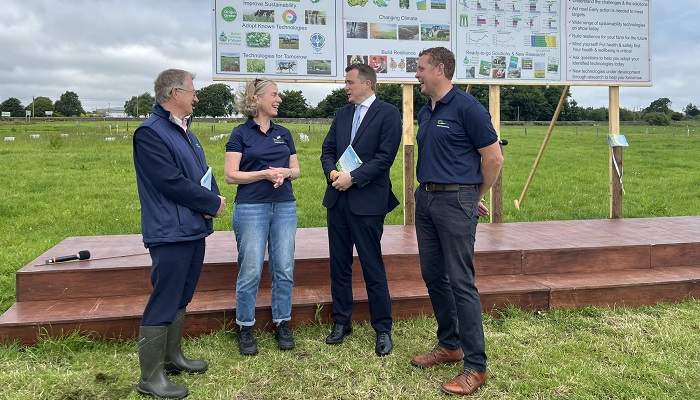
Pictured at the open day from left to right are: Professor Frank O’Mara, Director of Teagasc; Dr Karen Daly, acting Head of the Teagasc Environment, Soils and Land Use Research Centre; the Minister of State at the Department of Justice, James Browne T.D.; and Dr David Wall, Enterprise Leader at Johnstown Castle.
Speaking from the open day site in Teagasc Johnstown Castle, Teagasc Director, Professor Frank O’Mara said: “Teagasc has identified the technologies and farming practices that are important to help farms to become more resilient in the face of a changing climate.
“Technology will play a very big role in meeting the challenges, and there is a large research programme at Johnstown Castle and other Teagasc centres to develop and adapt the technologies.”
All the latest research and advice to support farmers on their journey to more sustainable farming were displayed.
Dr Karen Daly, acting Head of the Teagasc Environment, Soils and Land Use Research Centre said: “The many actions for sustainable and resilient farm systems spread across soil health, soil fertility, soil carbon sequestration, biodiversity, gaseous emissions and water quality were on display at Johnstown Castle today. All of the actions are scientifically robust to give farmers the confidence for adoption out on their own farms.”
Dr David Wall, Enterprise Leader at Johnstown Castle said: “We are asking each farmer to identify and implement the best solution for their farm business from a range of possible measures and look at the supports available from the Teagasc Advisory Service and other professionals.”
Emissions
Continued improvements in grazing management, breeding of efficient animals, reducing the age of slaughter and increasing home-grown feed supplementation will lead to further reductions in emissions.
In addition to these proven technologies for improving livestock production systems, newly-emerging technologies are being tested for Irish systems – such as feed additives for reducing biogenic methane and breeding of lower methane emitting animals in future – which hold the potential to reduce emissions further over time.
Water quality
Agriculture has a significant role to play in helping achieve good water quality targets. The Teagasc Better Farming for Water Campaign has a clear objective to reduce nutrient and sediment loss to water through its 8-Actions for change, focussing on nutrient management, farmyard management and land management. Good nutrient management planning is a major corner stone to reducing diffuse nutrient losses.
Also read: Huge amount of practice adoption required over next 10 years