
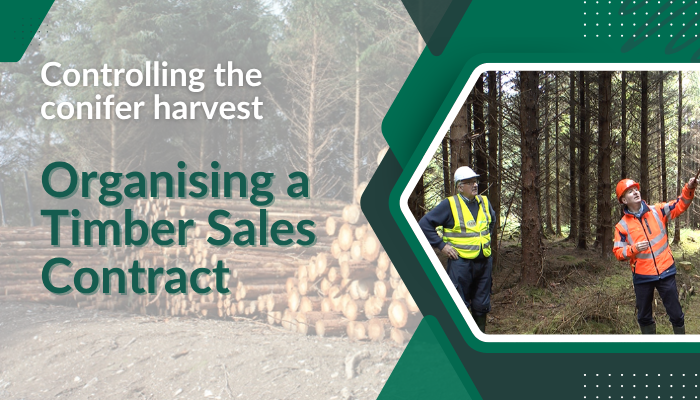
With harvesting of timber affected by previous storms ongoing, it is in every forest owner’s interest to be in control of the timber harvesting and sales processes. Teagasc forestry advisors continue to be available to provide objective guidance and support to forest owners.
In this second article in a series of eight, Teagasc forestry advisors highlight the importance of an appropriate timber sales contract.
It is strongly recommended to have an appropriate written contract with anyone involved in timber harvesting and sales in your forest (e.g. your forester, the timber buyer and/or harvesting contractor and the timber haulier). Verbal agreements are not satisfactory as they can be open to misinterpretation.
Engaging a forester
If employing a forester to oversee your timber sale, it is important to have an agreement drawn up setting out what services they will provide and the costs involved. Services may include co-ordination and support in the following key areas:
- Harvesting-related applications: Felling licence, harvesting plan, road grant etc. Bundling applications may save you fees.
- Preparing a risk assessment and site health & safety plan. Be aware of your responsibilities as the owner under the Health and Safety and Welfare at Work Act 2005.
- Deciding on how the timber will be sold, standing, roadside or delivered to the buyer.
- Carrying out a forest inventory to get an estimate of the total timber volume and average volume per tree.
- Estimating timber product assortments, percentages of pulp, stake, pallet and sawlog.
- Securing written quotes from a number of potential buyers. If selling roadside or delivered to the buyer, get quotes from harvesting contractors and hauliers.
- Managing and supervising the harvesting operations and timber security tasks.
- Inspecting the work to see if operations are in line with the contract and felling licence conditions.
- Liaising with the buyer on behalf of the forest owner/ seller.
Remember, as the owner, it is your responsibility to ensure that the conditions of the felling licence and the Health & Safety at Work Act are adhered to.
Important inclusions in your sales contract
A legally binding contract with a forester / buyer / harvesting contractor should be read through and understood to ensure it protects your interests and should include the following:
- Your identity as the seller and proof of ownership of the timber as well as contact details of the buyer.
- Location of the site, relevant site features, area to be harvested and the start and finishing dates.
- The price to be paid, including an agreed deposit, payment schedule and when the transfer of the timber ownership occurs.
- Method of measurement (volume (m³) or tonnes) and the categories of products (pulp, stake, pallet and sawlog).
- Agreement on road use, including maximum weights.
- Statement that harvesting will be carried out in accordance with best silvicultural practice and in compliance with the conditions of the felling licence, including the application of urea and dye on freshly cut conifer stumps.
- Written proof that the buyer, their employees/ contractor are fully compliant with, and are aware of their responsibilities under the Health & Safety at Work Act as well as written proof of operators/ contractor’s insurance cover and qualifications.
- Assign liability for property damage, including roads.
- Provision for the protection of the residual stand with penalties for unnecessary felling and damage; The maximum length of time timber is left at roadside and the associated penalties imposed due to moisture loss if sold by weight.
- Use of a “docket system” or other appropriate systems and designate times when timber lorries can enter the site.
- Provide for the termination of the sales agreement if any of the provisions of the contract are not adhered to with arbitration in the event of disputes between parties.
This is not a comprehensive list of what should be in your timber sales contract. The Irish Timber Growers Association have developed a very useful ‘Tree Sales Agreement’. It is important to have your solicitor give their professional advice on any contract drawn up. Some foresters/forest companies may also offer you a package where they undertake to harvest, transport and sell your timber. Management costs are generally charged as a percentage of the net timber value. Transparency in all stages of this process is very important. As the seller, you will be liable for all costs. Ensure the terms of such a package are covered under an appropriate contract.
Other factors to consider
- Who is buying the timber? The forester/forest company, a sawmill or other end user?
- What prices are being offered by the end user, get written quotes.
- Be clear of the costs involved.
- What are the responsibilities of the forester / forestry company?
- What are the tax implications?
On clearfelled sites, there is an obligation under the 2014 Forestry Act to replant. Some foresters/forest companies may offer to tie in a replanting contract with the above harvesting model. If you wish to avail of this, be fully aware of the conditions of the contract, how many years of management are included and seek a break down costs involved.
Teagasc provide independent and objective advice on all forestry issues. For further information, contact your local Teagasc forestry staff and visit the forestry section of the Teagasc website.