
25 January 2024
How much fertiliser can I buy?
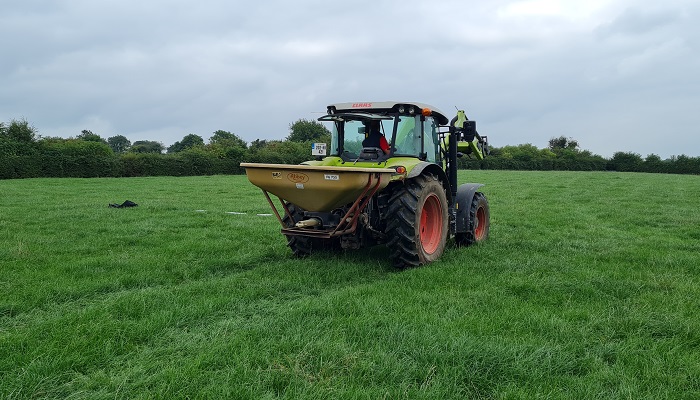
‘How much fertiliser can I buy?’ is a frequently asked question by farmers recently, writes Sean Mannion, B&T Advisor, Teagasc Galway/Clare, who tells us more on the National Fertiliser Database, the importance of calculating your stocking rate and soil sampling requirements.
95% of farmers have signed up to the National Fertiliser Database. This database captures the fertiliser purchased and sold. It can also be used to assist farmers in avoiding penalties for overuse. It is important to remember that concentrate and lime usage will also form part of the database. It is critical that farmers know their stocking rate in kg/N/Ha, as many farm regulations are enacted based on this figure. This gives an indication of how intensive or extensive your farming system is.
Stocking rate is calculated as the total annual nitrogen (kg) excreted by grazing livestock averaged over the net grassland area (grazing and silage area). For example, a farmer with 60 acres (24.3 Ha) and farming 22 cows, 21 calves, 21 yearlings and a stock bull for the full year would equate to a stocking rate of 132kg/N/Ha.
Every farmer should know their stocking rate. With regard to bovines only, this is captured on your Agfood account online. Ovine and equine calculations need to be done manually and added to the Agfood bovine figures. A lowland ewe and her lamb(s) has a nitrogen excretion rate of 13kg/year, a lowland hogget 6kg/year and a horse >3years is 50kg/year.
From the 1st January 2023, all farmers above 130kg N/ha have to take soil samples. Where soil samples are not taken, Index 4 for Phosphorus (P) will be assumed (no bag P or imported P can be used). From the same date, all tillage lands without soil samples are not allowed P fertiliser or imported organic manures. Therefore, farms in this category can no longer use P compound fertilisers, such as 18-6-12, 10-10-20 or 24-2.5-10. There will be penalties if excess fertiliser is used.
The saying often goes ‘you can’t manage what you don’t measure’. Advice on nutrient and trace element application rates must depend on the quantity of the element in the soil that is available to the crop. Apart from nitrogen, this is determined by soil analysis. If the soil analysis shows a deficit in phosphorus levels then you will have a tolerance to replenish this. If you already have soil analysis for your farm, these are valid for 4 years and must not represent an area greater than 5ha (12ac).
In the past, some farmers commonly purchased the same fertiliser compounds year on year, not knowing their soil analysis. Today, this needs be avoided or one may risk a penalty situation for breach of phosphorus levels for their farm.
Fertiliser Register
From now on, farmers who wish to purchase fertiliser must be registered as a professional end user with the National Fertiliser Database. 95% of farmers have done this since 1st September 2023. When a farmer approaches their merchant/co-op to purchase fertiliser, they will be required to provide their herd number once they are registered as a professional end user. If so, they will attribute the order of fertiliser to the new database using their herd number. If you are not registered you will not be able to purchase fertiliser.
There is no transaction limit on the National Fertiliser Database. However, it must be noted that the Department will use data from the National Fertiliser Database to confirm farmer compliance with obligations under Ireland’s Nitrates Action Programme and the Nitrates Derogation, both of which include limits on Nitrogen and Phosphorus as mentioned earlier. This is how many farmers may be found in breach and face potential penalties as a result. Sales for private domestic use, such as private gardens is not recorded.
Contact your agricultural advisor or agent to help analyse your soil analysis and identify the most suitable fertilisers for your soils.
Top tips:
- Become familiar with your farm stocking rate if you are unaware of it.
- Strongly consider soil sampling if you have not done so in the past 4 years.
- Identify the most suitable fertilisers for your soils.
Also read: Action needed to avoid ‘uphill battle’ on future nitrates derogations
Also read: Soil sampling for ACRES Tranche 1