
20 October 2023
Native woodland ferns of Ireland – the Hart’s tongue fern
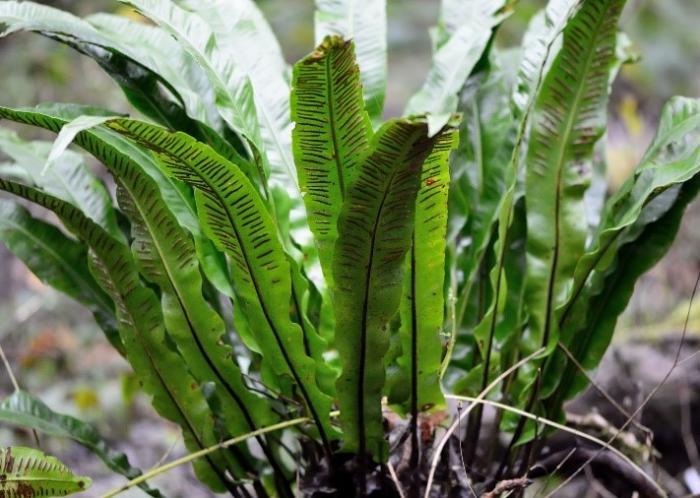
In the first part of a series, Rory Newell, Teagasc Forestry Technician, tells us more about the Hart’s tongue fern (Asplenium scolopendrium) – one of the most recognisable native Irish ferns.
A walk in the woods never fails to excite the senses, be it native woodland, forestry stands of mixed species or single species stands. One group of plants in particular will stand out of the shadows as an example of how well plants have adapted to their surroundings. This group of plants is the ferns and, for me, are a very rich and diverse group that are well adapted to survive and can thrive in many different types of habitat.
Ferns have always fascinated me and are masters of their sometimes very specific habitats. There’s always a fern that will find an opportunity to grow where other plants will not. So, with that said, let’s look in more detail at our native ferns, the types of places they like to grow and any folklore that may be associated with them.
The Hart’s tongue fern (Asplenium scolopendrium)
This is one of the most recognisable native Irish ferns. Its common name gives it a very visually accurate description of a tongue-like, frond which resembles that of a deer. When speaking of ferns we refer to the ‘frond’, this is what may otherwise be known as the leaf.
Many fern fronds die away for the winter dormancy period, but the Hart’s tongue is evergreen and will always have fronds present and can be observed at different stages of growth or decline. Old fronds are replaced by new fronds as the season progresses and eventually older fronds decline fully.
The Hart’s tongue fronds are deep green, long and strap-like, with a dark midrib running down the centre, giving this fern its distinct appearance. It is a clump-forming fern which spreads via rhizomes and is often found on slightly more alkaline soils (the rhizome is the part of the plant which is responsible for migration of roots via a shallow horizontal stem).
Hart’s tongue ferns are said to be a very good ancient woodland indicator species and are frequently found in both hedgerows and woodlands nationwide, contributing to their biodiversity.
When it comes to position, this fern is not fussy and will take advantage of any opportunity it can once the conditions are right. They can often be seen growing in old limestone walls although they can appear dwarf-like in comparison to ones which may be found in the woods or the hedgerows. This is a result of light and nutrient availability.
Ferns are highly regarded garden plants and have made the jump from our woodlands to our gardens as highly prized ornamentals. Having said that, it is greatly frowned upon to remove any plants from wild habitats and home them in your garden. In some cases it is also illegal to do so as plants are protected under the Flora Protection Order, 2022.
Like so many of the plants which surround us, the herbal benefits of which have been broadly forgotten, this fern is no different. In the past, it is said to have had many health benefits including treating coughs, open wounds and as a medicine for the treatment of digestive problems.
A quote taken from Culpeper’s “Complete Herbal” describes how “Hart’s Tongue is much commended against the hardness and stoppings of the spleen and liver, and against the heat of the liver and stomach, and against the bloody-flux”, all of which sounds like having this fern nearby would certainly have its merits.
Finally, but not surprisingly, there is also some evidence of it being used to brew an ale.
Just to close. These plants have always served us in ways that benefit us as a whole, but stopping short of brewing an ale, the real admiration for these plants can be derived through observing and protecting them in their natural habitat and that calming appreciation one gets from their presence.
To be continued…