
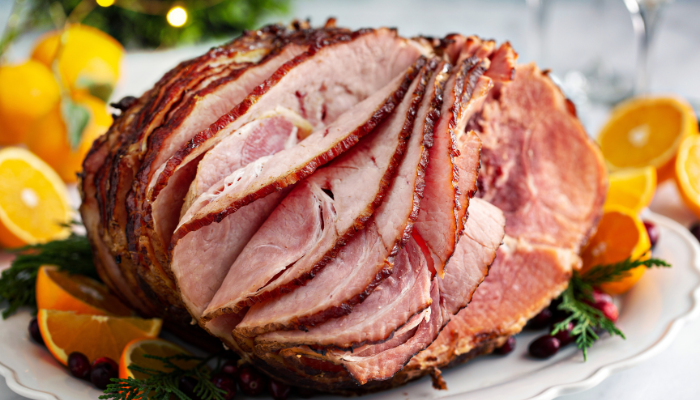
For many Irish households, Christmas dinner wouldn’t feel complete without a glazed ham sharing centre stage with the turkey. Ciarán Carroll describes the journey of your Christmas ham, from farm to fork.
The story starts on Ireland’s pig farms, where producers focus on rearing healthy animals to the highest standards. Across the country, around 260 pig farms operate at varying scales, with the typical farm managing just over 500 sows.
Farmers select well-established breeds such as Large White, Landrace and Duroc, the latter prized for its rich flavour. Pigs are raised in carefully controlled environments designed to protect their welfare and wellbeing. Their diet is balanced using ingredients like barley, wheat, maize, beans, minerals and vitamins to support growth and meat quality.
In roughly six months, pigs reach their target weight of 110kg to 120kg. At this stage, they move to processing facilities where strict standards ensure both animal welfare and food safety.
Turning pork into Christmas ham
Once processed, the pig’s hind leg, the cut used for ham, is prepared for curing. This is where pork becomes ham. Traditionally, salt alone was used to preserve meat, but today most producers rely on brining. A brine typically contains water, salt, sugar and sometimes nitrates, and is either injected into the meat or used to soak it. This allows the flavours to penetrate evenly while helping the ham retain moisture. Depending on the method, curing can take anything from a few days to several weeks.
For those who favour smoked ham, an additional step follows. The cured meat is gently smoked over hardwoods such as oak or hickory. This slow low-temperature process infuses the ham with a deep aroma that many people associate with Christmas.
Cooking, glazing and finishing touches
Some Christmas hams are fully cooked before they reach the shops, making them easy to prepare at home. Many are finished with a glaze, often a blend of honey, brown sugar, mustard and spices. When baked, the glaze melts and caramelises, creating the glossy, golden crust that looks as good as it tastes.
The Teagasc Pig Development Department has produced a video guide showing how to cook your Christmas ham to perfection.
The result is a tender, flavour-packed ham, perfect for serving hot with festive trimmings. And if there are leftovers, cold slices in sandwiches or salads in the days that follow.
When shopping for your ham this year, look out for the Bord Bia Origin Ireland logo for assurance that the ham was born, reared and processed in Ireland, and a simple way to support Irish pig farmers this Christmas.
For those who enjoy sausage meat at Christmas time, Teagasc Pig Development Department has also produced a video recipe for Festive Irish Sausage Rolls.