
14 July 2023
Weaning lamb performance from the INZAC flock
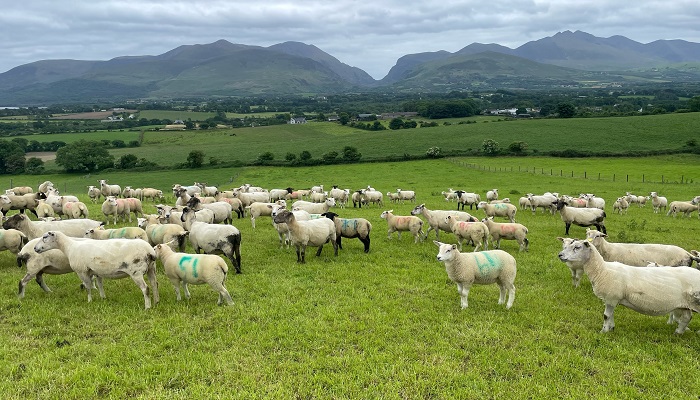
Fiona McGovern, Animal & Grassland Research and Innovation Centre, Teagasc Athenry, Co. Galway reports on the latest from the INZAC and breeding flocks at Athenry.
Thankfully over the past week, mid June, we have seen some thundery rain showers in Athenry, which were definitely needed to get grass growth back on track. Growth is currently 45kg DM/ha, but we are expecting this to pick up now that the rain has returned. All lambs in the INZAC flock were weaned on June 15th, at approximately 98 days of age.
As part of INZAC phase II, we have a fourth treatment group of New Zealand (NZ) x high Irish (HI) animals. Average weaning weights for the four groups were 38.6kg NZ, 36.2kg HI, 31.6kg low Irish and 35.5kg (NZ x HI). Despite the harsh start in spring, the good weather in May really boosted lamb thrive, with growth rates averaging 260-310g/day pre weaning across the treatment groups.
All lambs in our flock are ultrasound scanned for back fat and muscle depth as part of the Sheep Ireland Programme. The first group of lambs are scanned in early July, after which we can select our replacement ewe and ram lambs and begin drafting lambs for slaughter. We are continuing to monitor the faecal egg counts (FECs) of lambs. It is important to regularly monitor this to avoid unnecessary treatment. Group samples are collected via FECPAK once every fortnight and once counts are over 600 eggs per gram (EPG) all lambs are dosed. To date, our lambs have received one drench for nematodirus and one drench post weaning. All lambs receive a cobalt drench fortnightly at weighing.
At this point, all ewes have been thoroughly examined and cross-checked against lambing records in order to make culling decisions and to avoid holding onto problem ewes within the flock. At weaning ewe body condition score (BCS) was higher than we’ve seen in previous years, with ewes averaging 3.4 BCS. Ewes have been restricted post weaning but will be given access to good quality grass from now until mating with any thin ewes (BCS <3.0) getting preference. Ideally, we would like our ewe BCS to be 3.5 on average at mating, which for us is the beginning of October.