
10 January 2024
Risk to colostrum quality from poor-quality nutrition pre calving
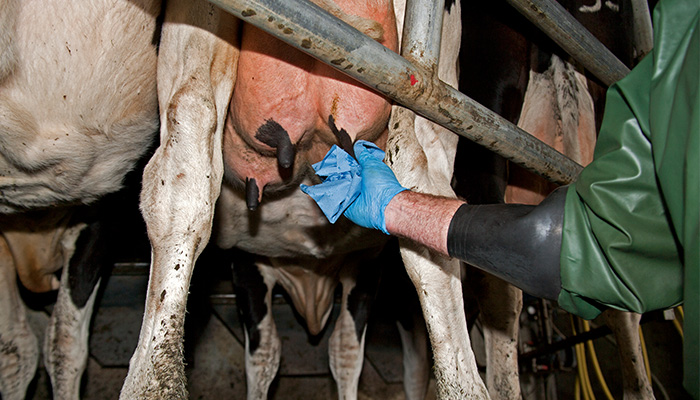
With the spring-calving period fast approaching, dairy farmers have been warned of the risk poor quality nutrition in the period immediately prior to calving can pose to colostrum quality.
Providing calves with adequate volumes of high-quality colostrum – the cow’s first milk – is vital for the protection of calf health during the rearing period and performance subsequently, Teagasc Dairy Specialist Stuart Childs told farmers attending a recent Teagasc / Animal Health Ireland (AHI) CalfCare Event in Co. Cork.
Reminding those in attendance of the Colostrum 123 rule – a three-step feeding regime considered best practice from the new-born calf – Stuart said that colostrum from the first milking should be used for the first feed (step 1). This should be provided within the first two hours of life (step 2), and offered at a feeding rate of at least three litres (step 3).
“While following the Colostrum 123 rule is a challenge, it is an effort well worth making. It will help protect the health of your calves, provided the colostrum being fed is of good quality,” Stuart explained.
Despite the importance of high-quality colostrum, Stuart noted that difficult weather conditions last summer and the production of poorer quality silage on many farms as a result may have a negative effect on the quality of this vital feed this spring.
“You could go through the effort of following the Colostrum 123 rule and yet because your feeding regime isn’t appropriate or your silage is of poor quality – which is a real risk on farms this year – the quality of colostrum produced might suffer.
“If the protein or energy level of the feed your cows are consuming before they calve is low, colostrum quality will be compromised. If you have your silage tested, examine the results. If the crude protein is below 12%, you need to introduce a protein source to the cows over the next couple of weeks in order to boost the quality of colostrum produced,” Stuart explained.
A good indicator of insufficient protein within the diet prior to calving, Stuart commented, is cows not producing significant quantities of colostrum at the point of calving, but he noted that this can be remedied relatively quickly through supplementary feeding for 7-10 days with a protein source prior to calving.
Calf feeding programmes
Feeding programmes for calves in the post-colostrum feeding period were also discussed at the event (see table 1 below). On farms where there are no underlying cow health issues, such as Johne’s disease, calves should be fed transition milk (milkings two to six after calving). This is recommended as the transition milk is a better quality feed source than whole milk or good quality milk replacer.
After the calf has received all feeds of transition milk, it should be offered whole milk (not waste milk) or good quality milk replacer, with the quality offered increased over the first week of life to ensure that calves are drinking 6L/day by the time they are six days old.
Table 1: Recommended feeding rates for calves
| Days | Milk type | Litres/feed | Feeds/day | Meal |
| 1 | Colostrum | 3 | 2 | |
| 2-5 | Transition milk | 2.5 | 2 | Access |
| 6-28 | Milk replacer / whole milk | 3 | 2 | Ad-lib |
| 29-56 | Milk replacer / whole milk | 3 | 1 or 2 | Ad-lib |
| 57-70 | Milk replacer / whole milk | 3 | 1 | Ad-lib |
David White of Volac offered advice to farmers going down the milk replacer route, explaining that calves require 750g of milk powder per day, offered through a feeding rate of 6L of mixed milk daily (12.5% dilution rate).
On this level of feeding, he said: “Historically, calves were fed 500g of milk powder in 4L of mixed milk each day. The thinking on this has now changed, as 400g of this powder was being used for maintenance of the calf alone, with only 100g being available for growth.
“At a feeding rate of 750g of powder per day, 400g will still be used for maintenance but 350g will be available for calf growth, which is essential if we are to reach the 0.7kg/day weight gain target.”
Highlighting the importance of this, he said: “If you feed the calf well in the first 8-12 weeks of life, then you get an extra lactation, you get more milk solids and the cow stays in the herd longer.”
For the beef calf rearers in the audience, Stuart pointed out that the good start is equally important for the beef calves. Keeping them well fed will help underpin immune function so that animals will stay health if combined with good husbandry practices overall and this will result in animals that will thrive throughout their lifetime and finish earlier as a result which is good both for reducing greenhouse gas emissions from the beef sector but is also good financially for the farmer.
The Volac representative also commented on the importance of calibration – whether an automatic or manual calf feeding system is used. The volumes of powder used must be weighed regularly to avoid any inconsistencies in terms of feeding rates, while excessively hot water temperatures (38 degrees C or above) should be avoided to prevent the proteins within the milk replacer denaturing during the mixing process.
The Teagasc/AHI CalfCare events will continue over the coming weeks. To find the nearest event to your farm, click here.
For more information on calf rearing, click here.