
28 October 2022
Teagasc research into thinning practice will increase returns from commercial forestry operation

Dr Niall Farrelly, Teagasc Forestry Development Department, tells us how Teagasc research into thinning practice will increase returns from commercial forestry operation.
Many farmer-owned plantations of Sitka spruce are progressing well and showing exceptional growth rates in Ireland, its timber known as white deal represents over 80% of the harvest volume in Ireland and is suitable for a range of forest products from pulp, pallet, panel board to construction timber. The species perhaps does best on mineral soils where increased fertility producesyields in excess of 24 cubic metres per year. Of the 140,000 ha privately ownedowned plantations of Sitka spruce are capable of producing yields in excess of 24 cubic metres per year. This offers an opportunity to increase profitability of the farm forest enterprise, especially if a productive plantation receives prompt and appropriate management. Appropriate management involves the improvement of the crop through thinning where the site permits. The thinning operation offers the potential to improve the remaining crop in that it removes crooked or less valuable trees (pulp and pallet wood) and retains the stronger straight trees to produce logs with increased commercial value for final harvest.
For fast growing stands of yield class 24 or above (growing to 12 m tall after 15 years), planning for thinning needs to take place at 12 years with preparation of roading infrastructure and application of felling licenses. The crop will be ready for thinning once the mean diameter at breast height is greater than 15 cm and where the number of trees is 2200 per hectare or greater. This can be as early as 15 years, see https://www.teagasc.ie/crops/forestry/advice/timber-harvesting/thinning-ready-reckoner/
First thinning removes approximately 30% of the crop volume, this can equate to 50 to 70 m3 per ha. Every 7th or 8th line is removed systematically removing 12 to 14% of the volume and poor quality trees are removed between the lines (Figure 1 It is recommended to removed dead, dying, supressed, crooked trees and wolf (big rough) trees at this stage between the lines, removing an additional 40 to 60 m3 depending on the intensity of thinning (Grade)), thin more conservatively or lighter when removing larger trees or where worries exist about stability (grade B). The majority of the harvested trees should be suitable for pulpwood, with some stake wood possible if local markets exist. Approximately 25 to 35% of the harvested volume should be pallet as higher proportions of pallet being removed risk loss in future value of the crop (Figure 2). Returns are dependent on timber prices and volume removed and can range from €700 to €900 per hectare based on current prices (October 2022) and thinning intensity.

Figure 1: A medium thinning (grade C) after second thinning, showing the progressing of log development.
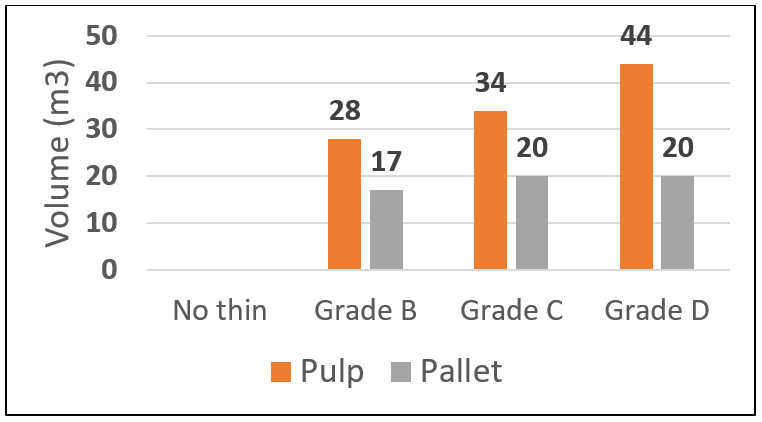
Figure 2: Volume of pulpwood and pallet-wood removed in first thinning according to increasing intensity of thinning
“The revenue achievable in second thinning is dependent on the quality of the first thinning operation. A good first thinning will pay dividends at second thinning as volume removals of pallet-wood should increase”.
A second thinning is recommended following 5 years growth at age 20 years, volume removals will be similar or lower than at 1st thinning (50 to 70 m3 per ha) and the revenue returns in second thinning are dependent on the quality of the first thinning operation. A good first thinning will pay dividends at second thinning as volume removals of pallet-wood should increase, lighter 1st thinnings may result in lower revenue returns as more pulpwood is required to be removed in 2nd thinning (Figure 3). Expectations of revenue returns range from €450 per ha with a light 1st thinning increasing to €1,300 per ha in the heavier thinning, as the mean tree size is greater owing to increased growing space provided in 1st thinning operation.

Figure 3: Volume of pulpwood and pallet-wood removed in second thinning according to intensity of thinning
“The cumulative impact of good practice is the production of sawlog at third thinning (albeit at low quantities) and an increase in the volume of straight logs remaining for final harvest”
A third thinning after a further 5 years at age 25 is a good option before final harvest. At this stage, if competition between trees needs to be reduced it will permit the production of some small sawlog (3.7 m lengths) or larger sawlog (4.9 m lengths), with more produced in the medium and heavy thinning options (Grade C & D) due to the benefits of increased growing space made available in the 1st and 2nd thinning operation. Return of €1500 to €2500 per hectare are achievable. Stocking should be in the region of 650 to 950 stems per hectare after third thinning depending on thinning intensity (Grade). A notable feature of thinning is that the volume of the average tree in all thinning treatments ranges from 0.6 to 0.7 m3 and this is considerably larger than the trees in the unthinned plots which is considerably smaller at 0.4 m3. A target final crop tree volume of 0.8 m3 will be achievable in a couple of years. A good thinning operation should demonstrate that the timber quality is improving and that the majority of the volume occurs on straight trees so that a considerable proportion of the final harvest volume is composed of valuable sawlog (Figure 4).
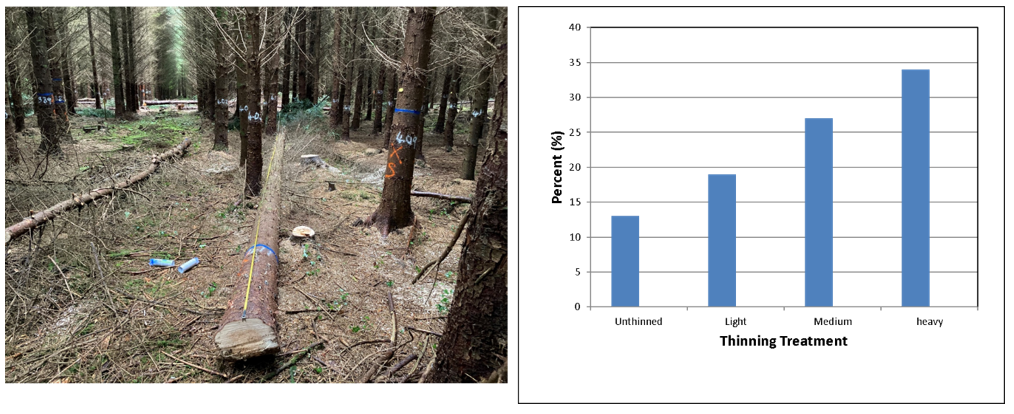
Figure 4a&b: A good first and second thinning operations resulting in the harvesting of small sawlog in third thinning (a) and improvement in log straightness of the remaining crop(b)
Summary of research findings
- Thinning offers income at 15, 20 and 25 years in the lifecycle of a plantation, whereas no income is generated until clearfell where no thinning is practiced.
- The three thinning operations as illustrated show cumulative returns of €2,700 to €4,500 per Ha
- Moderate (Grade C) and heavier thinning (Grade D) provide more thinning revenue than lighter thinning (Grade B)
- Merchantable size of 0.8 m3 is achievable with thinning in 30 years.
- Increasing the selection intensity in thinning improves the volume of straight logs which will pay dividends at final harvest
- Continued research in best practice in thinning will provide a pathway to improve the competitiveness and increase profitability of the farm forest sector.
The Teagasc Forestry Department issues an article on a Forestry topic every Friday here on Teagasc Daily Subscribe to: Forestry e-News Keep up-to-date with the Teagasc Forestry Department or follow them on Social Media