
22 October 2023
Growing Wild – Ivy flowers and Common knapweed
Now is the time to look out for Ivy flowers and Common knapweed. Catherine Keena, Teagasc Countryside Management Specialist, who takes a closer look at some of our native Irish biodiversity.
Ivy flowers
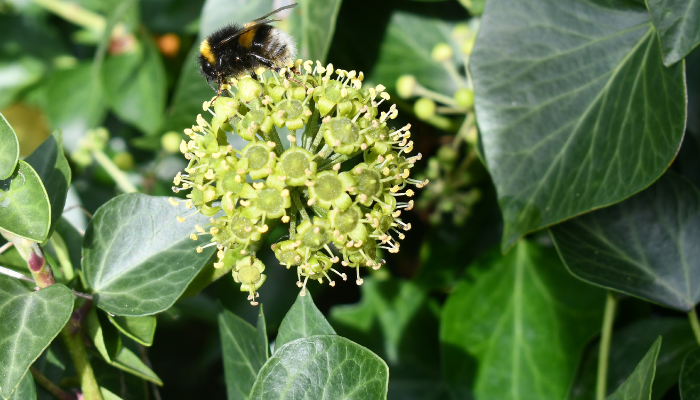
Look out for ivy flowers, which on any dry day are sure to be covered in bees, wasps, flies and butterflies, as well as moths when they come out in the dark. Some are attracted by the putrid smell of fairly inconspicuous lime-yellow flowers on the crown of woody stems amid oval untoothed leaves – characteristic of the flowering stage of ivy. Five pointed green petals reflex backwards with the dome in the centre oozing nectar, at this time of year when nectar is scarce. Ivy is a foodplant of the holly blue butterfly, whose eggs are laid on the flowers. Love or hate it, ivy is part of our native Irish biodiversity.
Common knapweed
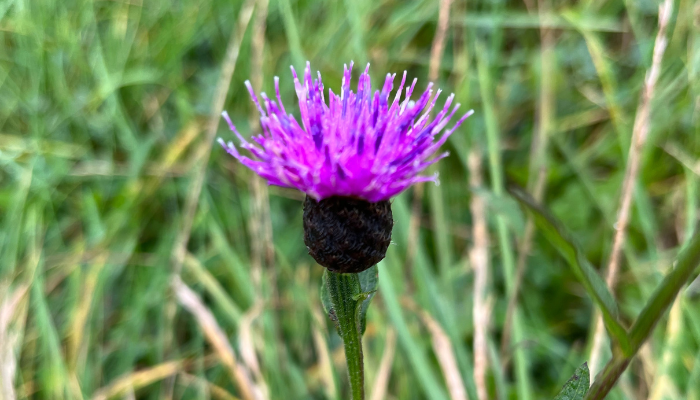
Look out for common knapweed – one of our later flowering plants. Many of the deep purple compact flowerheads have turned into the black seedheads which remain on their hard branched stems which last throughout winter, while occasional flowerheads stand out at this time of year. Because of the black seedheads it is also known as black knapweed or blackheads. With many insects using the seedheads and others feeding on its leaves and stems – knapweed may be supporting over fifty invertebrates in a complex foodweb, with many of the gall flies, gall midges and small moths feeding on knapweed in turn being preyed on by predatory flies. Common knapweed is part of our native Irish biodiversity.
See previous Growing Wild articles below:
- Growing Wild – Meadowsweet, Ox-eye Daisy and Selfheal
- Growing Wild – Marsh marigold and Ribwort plantain
- Growing Wild – Dandelions and cowslips
- Growing Wild – Lesser Celandine and Ivy berries
- Growing Wild – Winter Heliotrope and frogspawn
- Growing Wild – Willow Catkins and Birds Nests
- Growing Wild – Harts Tongue and Hazel
- Growing Wild – Whins and Ferns
- Growing Wild – Rose Hips and Flowering Ivy
- Growing Wild – Yarrow and Herb Robert
- Growing Wild – Elderberries and Blackberries
- Growing Wild – Haws and Spindle
- Growing wild – Guelder Rose and Sloes
- Growing wild – Purple loosestrife and Lord and Ladies
- Growing Wild – willowherb and water mint
- Growing Wild – dandelion and greater stitchwort
- Growing Wild – willow, primrose and lady’s smock
- Growing Wild – whitethorn and cow parsley
- Growing Wild – bluebells and guelder rose
- Growing wild – Honeysuckle and Foxglove
- Growing Wild – Elder and Ragged Robin
- Growing wild – dog rose and meadowsweet
- Growing wild – Privet and Lady’s Bedstraw
- Growing Wild – Bird’s foot trefoil and Knapweed
Keep an eye on Teagasc Daily for Growing Wild updates. Learn more from Teagasc about Biodiversity and Countryside here.